AI Governance Starts
in the Browser
Your employees use AI tools every day. Most of that usage happens through unapproved accounts, on unapproved tools, with zero visibility for IT. Shadow Defend fixes that. From the browser, in minutes, without touching your network.
The governance gap
AI adoption isn't waiting for your security team
Your employees aren't being reckless. They're being productive. But every prompt they send to an unapproved AI tool is corporate data leaving your perimeter with no record, no policy, and no way back.
of employees paste corporate data into AI tools
Contracts, source code, patient records, credentials, copied straight into personal ChatGPT and Claude accounts.
LayerX Data Security Report, 2025
of that sharing goes through personal, unmanaged accounts
Corporate IT has zero visibility. No data retention agreement. No training opt-out. No audit trail.
LayerX Data Security Report, 2025
DLP violations triggered by ChatGPT alone (99% YoY increase)
Traditional DLP sees file transfers. It can't parse a natural-language prompt or a copy-paste into a chat window.
Zscaler ThreatLabz, 2026
Four forces making AI governance non-optional
Regulatory obligations are here
EU AI Act Article 50 transparency obligations took effect August 2026; standalone high-risk obligations were deferred to December 2027. HIPAA, GDPR, CCPA, and SEC all apply to AI-processed data. No AI governance policy means no defensible compliance position.
OWASP named it a top risk
Sensitive Information Disclosure is the #2 risk in the OWASP Top 10 for LLM Applications 2026. Shadow AI & Unsanctioned Data Flows is a named risk category in the OWASP GenAI Data Security framework.
AI agents are amplifying the problem
Excessive Agency climbed to #3 on the OWASP list, the biggest mover. When an AI agent acts autonomously, every data-leakage risk becomes automated, persistent, and chained.
The cost of inaction is measurable
Shadow AI adds an average of $670K to breach costs (IBM 2025). 67% of workers already use AI at work, yet 17% of organizations that allow AI still have no AI policy in place (PYMNTS, 2025).
Why the browser
The browser is the last mile for AI data loss. And the first mile for governance.
You can't govern AI from the network perimeter. DLP inspects files, not conversations. DNS filters see domains, not prompts. CASB policies stop at the login page.
The browser is the only place where you can see what is being shared, with which tool, by whom, and act on it before the data leaves.
"The fix is at the data surface, not the model."
OWASP GenAI/LLM Top 10, 2026 (LLM02: Sensitive Information Disclosure)
It's where AI actually happens
80% of enterprise work happens in the browser (Menlo Security, 2024). ChatGPT, Claude, Gemini, Perplexity, DeepSeek: they're all browser tabs. A browser extension sees every AI interaction at the point it occurs.
Sees AI use even on personal accounts
Network-level tools only see the domain or enterprise API traffic. A browser extension sees the actual prompt content, even when an employee is logged into a personal ChatGPT account on a managed browser. That's the 82% of sharing you're currently missing.
Produces evidence, not just alerts
Every AI interaction is logged to a queryable audit trail with sensitive patterns auto-redacted. When a regulator asks "what AI governance controls do you have?", you have the answer.
How it works
Discover. Detect. Defend.
Start in audit mode to discover what's happening in real time. Detect risk and guide behavior with warnings. Then defend your data, selectively blocking only high-risk activity. Each step builds on the last.
Discover
Discover Shadow AI
Automatically discover every AI tool your team uses: ChatGPT, Claude, Gemini, Copilot, DeepSeek, and new ones as they appear. See who is using what, how often, and on which tools. Because detection happens at the browser, you catch AI use even through personal accounts that network-level tools can't see.
- Automatic AI site identification
- Catches AI use even on personal accounts
- Continuous provider catalog updates
- No list to maintain. Nothing goes stale.
Best for
Initial deployments and proof-of-value. See the full picture before setting policy.
Detect
Detect risk in real time
Inspect prompt content for PII, credentials, source code, and regulated data before it reaches any AI tool. Flag policy violations and risky behavior in real time, not after.
- Smart sensitive data detection (PII, secrets, code)
- Real-time user notifications with risk context
- Justification workflows for borderline cases
- Alerts to Slack, email, webhooks, or SIEM
Best for
Building secure habits. Guide employees toward approved tools with real-time nudges.
Defend
Defend your data
Defend against the highest-risk transfers: source code to unapproved tools, patient data to personal accounts, credentials in any prompt. Only after discovery and detection have established the right context.
- Block before submission for critical data
- Warn before submission for risky prompts
- Auto-create incident records
- Audit-ready evidence with auto-redaction
Best for
Regulated data: source code, API keys, customer PII, PHI, financial records.
Every interaction is logged to a queryable audit trail with sensitive patterns auto-redacted. When a regulator, insurer, or board asks what you're doing about AI governance, the evidence is there.
See it in action
Policies that fit how your team actually works
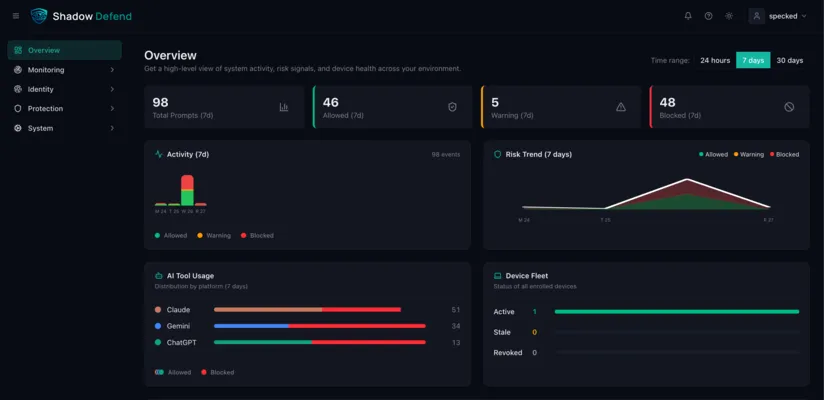
Allow approved tools, warn on risky behavior, block what must be stopped. Each AI tool gets the right response based on your organization's rules, not a blanket ban. Because Shadow Defend inspects prompts at the browser layer, policies apply whether an employee is on a personal or enterprise account, usage your network tools can't see.
Policies are defined once in the admin dashboard and enforced across every managed browser in your organization. No per-device configuration. No list to maintain.
Real scenarios
The incidents happening in your organization right now
These aren't hypothetical. They're the everyday actions of well-meaning employees trying to be more productive, and the governance gaps they create.
Healthcare
HIPAA, HITECH
Clinician copies patient notes into Claude to help write a referral letter.
PHI is detected before it leaves the browser. The prompt is blocked before submission, preserving patient privacy, and the attempt is logged for the compliance team.
Legal
ABA Ethics, Client Confidentiality
Associate uploads a privileged contract to an AI summarization tool found on Google.
Shadow Defend blocks the upload to an unapproved tool, preserving attorney-client privilege, and logs the attempt for the compliance team.
The pattern is always the same: well-meaning employee, unapproved AI tool, sensitive data. Shadow Defend breaks that chain at the browser. See how it plays out in financial services, legal, and technology too.
Explore all use casesAudit readiness
Six questions your auditor will ask. One audit trail that answers them.
Regulators, insurers, and boards are already asking. Shadow Defend turns every AI interaction into queryable, exportable evidence.
Pricing
Start free. Scale when you're ready.
No credit card to start. Every paid tier includes the full policy engine.
Pro
Policy enforcement and audit trails for growing teams.
Every week without AI governance is a week of untracked risk
Your employees are using AI right now.
Do you know what they're sharing?
Most companies discover their AI governance gap after an incident, and 63% of breached organizations lacked an AI governance policy (IBM Cost of a Data Breach 2025). Shadow Defend gives you visibility in minutes. Free, from the browser, with no infrastructure changes. Start with 10 devices and see what's really happening.
Risk scoring runs locally. Sensitive patterns auto-redacted in the audit trail. No keystroke logging. DPoP-bound tokens.
How we handle your data